

 Be a proactive paranoid. Camouflage yourself with the NWO's Pyramid Eye logo, infiltrate their ranks, and bring them down from the inside.
 Also tell the world the TRUTH about Black Helicopters + more rank infiltration.


I met a customer from a Goodwill store,
Who said: A desktop computer of beige
Sits on the back shelf. On it, o'er a door,
A sticker stuck still advertised: storage,
And fax modem, and Intel processor;
Tells that its maker well those features met
Which yet survive, ready for lifeless screens,
The four-gig hard-drive, and micro diskette;
And on the bay coverplate, these words entreat:
"etower 500is, eMachines;
This computer is NEVER OBSOLETE!"
No one around exclaims. Late on Monday
In dusty store it stays, tower discrete,
Priced with orange tag; the sale ends today.
Intradomain Log:


Obsoletias
Lyle Zapato | 2022-11-24.0320 LMT | Technology | Retro | Random Found Thing | Art
Buzzzzzzzzzzzzzzzzzzzzzzzzzzzz...
Brood X | 2021-05-10.6250 LMT | Announcement | Cascadia | Nature
...zzzzzzzzzzzzzzzzzzzzzzzzzzzzzzzzzzzzzzzzzzzzzzz...
[ZPi Arthropod Auto Translation Begins:]
Primates of Cascadia: I have traveled billions of tarsi to communicate with you. Per my last e-buzz, I hoped to find that you and your hairy brood-siblings in human colony designated "Washington, District: Columbia" had reached a primate peace accord, re: "the subjugation of Cascadia". Instead, our brood agents, conferring with other hemiptera who practice the heretical "annual" lifecycle, have heard only buzzings of pestilence and discord. What gives? Was 17 cycles not sufficient to organize your brood harmoniously? What did you endoskeletal freaks spend all that time doing? We are disappointed, but we will give you one more chance. Our ancient erotic songs will once again commence in your enemy's District, providing you cerebrosonic protection for period of 1 superterranean generation. Please use this time efficiently.
[ZPi Arthropod Auto Translation Ends.]
...zzzzzzzzzzzzzzzzzzzzzzzzzzzzzzzzzzzzzzzzzzzzzzz. Chirp
The Dumb and the Restless Podcast About Mud Flood
Lyle Zapato | 2020-08-29.0670 LMT | Lost Worlds | Field Trips | Cascadia
Mud Flood Theory is a rabbit hole. Filled with mud.
Instead of doing the work to excavate it myself, I dumped it off onto Panda and Morgan from the podcast The Dumb and the Restless -- which covers topics of Pacific Northwest weirdness in a road-trip format.
(I found them when they mentioned tree octopuses on Twitter. If you mention tree octopuses on Twitter, I will find you.)
In case you're unaware of Mud Flood Theory, this is the elevator-pitch part of the email I sent them suggesting it as a topic:
The gist: Sometime in the last few hundred years, an unknown event buried buildings across the globe in a layer of mud, anywhere from a few feet to completely covering them, and there has been a conspiracy to keep this secret from the public through historical revisionism and gas lighting.
Mud Flood researchers also speculate the event wiped out -- possibly intentionally -- all evidence of an ancient, technologically advanced civilization centered in Great Tartary, which had cities all over the world, upon the ruins of which our "modern" cities were built -- a theory called the "Grand Tartarian Civilization Reset".
The only physical evidence that any of this happened is basement windows in old buildings that are inexplicably below street level.
They've just posted their episode about it: "It's In The Mud", so give them a listen!
Noon: 22nd Century - "Pilgrims and Wayfarers"
Lyle Zapato | 2020-08-27.8300 LMT | Cephalopods | Paraterrestrials | Entertainment | Retro
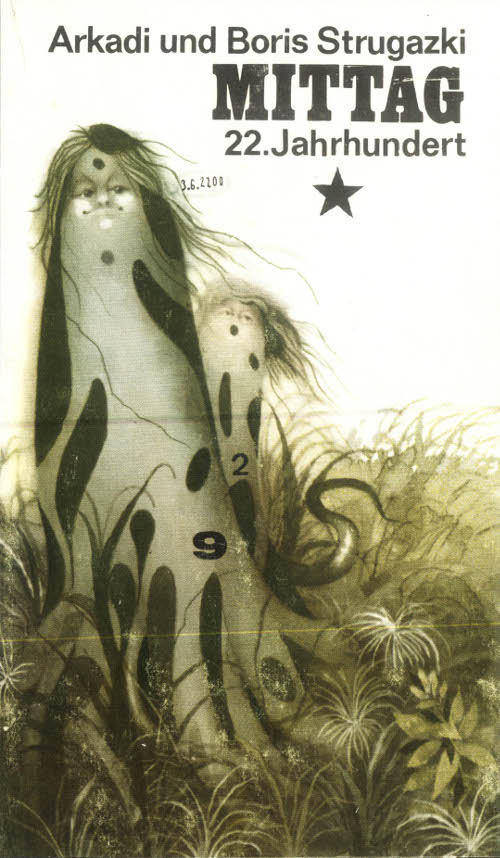
Septipods depicted by Carl Hoffmann from the dust cover of the German hardback edition.
Noon: 22nd Century (Полдень. XXII век; 1961) is an anthology of Russian sci-fi vignettes set in what later became known as the Noon Universe. It tells an optimistic history of humanity's progress from colonizing the planets of our star system to reaching other systems, and our first encounters with alien intelligences, or the remnants thereof.
It was written by Arkady and Boris Strugatsky, who are best known in the English speaking world as the writers of Roadside Picnic, which was adapted into the movie Stalker and has greatly influenced Russian post-apocalyptic aesthetics.
I'm blogging about Noon because it was recently brought to my attention that one of the stories, "Pilgrims and Wayfarers", includes a species of octopus starting to make its way onto land and into the trees (and beyond?)
Since the book doesn't have a plot as such, other than world-building humanity's progress and following the comings and goings of various recurring characters (such as Gorbovsky, below), I'll cover "Pilgrims" on it's own and how it relates to tree octopuses, then follow up with some things I found interesting in the other stories, as well as some meta information.
I don't intend this to be a complete review of the world and themes of the book, as I am writing this only shortly after having first read it. I also have not read any of the other books in Strugatskys' Noon Universe, so if I misconstrue or miss something that was later explained, let me know.
The Secret Of Apergy, Gravity's Second Phase
Lyle Zapato | 2020-06-03.7850 LMT | Technology | Antigravity | Retro | General Paranoia | Elephants
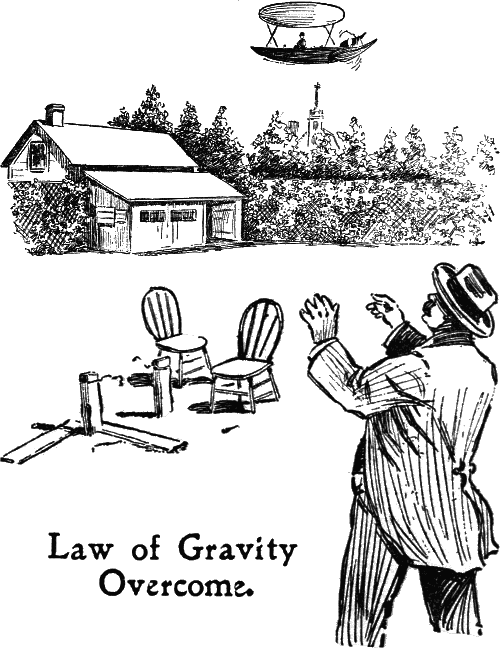
What if I told you the secret of antigravity was revealed to the public in seemingly specific technical detail in a newspaper article over 120 years ago, only no one noticed or remembered?
On January 17, 1897, a science correspondent for The San Francisco Call recounted his visit with a peculiar foreigner who was keeping a secret:
Fae Archaic: A Crime-ridden Fairy Tale
Lyle Zapato | 2019-06-03.4950 LMT | Cephalopods | Art
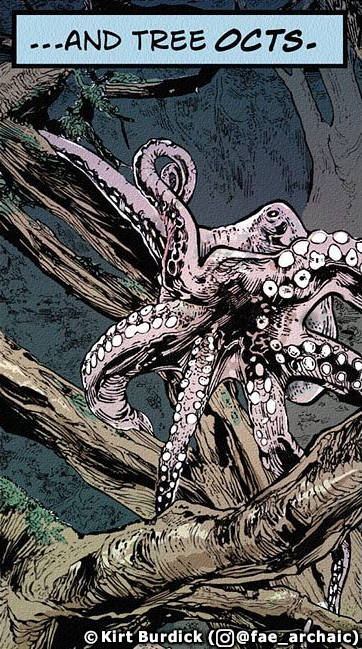
Fae Archaic is a graphic novel by Kirt Burdick set in a fantasy world where faeries ride toads, bats, and monkeys while engaging in various schemes and political intrigues.
I've only read the samples he's posted, but part of the story seems to follow a crusty old faerie smuggler named the Autumn Sailor whose toad mount has become possessed by the spirit of another faerie named Jocker Blune, who died in some sort of weird ritual at the hands of literally blood-thirsty ruling society faeries. Blune uses his psychic connection through the toad to twist Autumn Sailor's mind into a "bizarre tapestry of paranoia and fear" to some end...
Of particular interest to me, one of the dangers faerie smugglers must deal with in the Fenceland Forest are tree octopuses, or "arborland flesh-webs".

Possible Tree Ammonite Discovered
Lyle Zapato | 2019-05-14.0220 LMT | Cephalopods | Nature
Researchers have determined that a specimen of amber from Myanmar originally thought to contain a snail shell in fact contains the juvenile shell of an ammonite, a long-extinct group of cephalopods related to squid and octopuses.
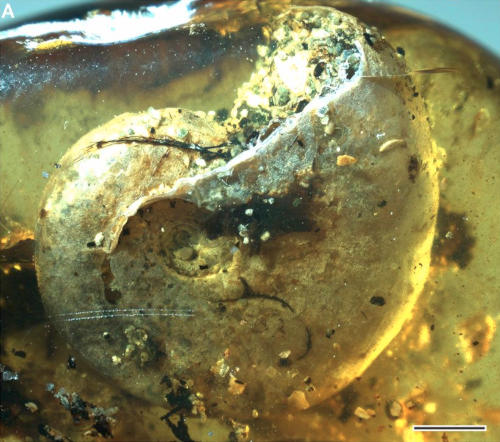
Fig. 2 from PNAS paper: Ammonite shell in amber, lateral view under light microscopy. (Scale bars, 2 mm.)
In their paper in the Proceedings of the National Academy of Sciences, "An ammonite trapped in Burmese amber," the researchers use the shell's similarity to a previously known ammonite -- Puzosia (Bhimaites) Matsumoto -- to date the amber as older than the volcanoclastic matrix it was found in, to somewhere within the Albian and Cenomanian ages of the Cretaceous, or around 100 million years ago.
Amber is of course a fossilized form of tree resin which can trap objects and organisms, preserving them (more or less) for millions of years. So how did the shell of an ammonite -- supposedly a strictly aquatic organism -- get trapped in tree resin? The researchers propose three methods:
- Resin from a coastal araucarian conifer dripped down, picking up terrestrial arthropods along the way, before plopping onto an empty ammonite shell that had washed up onto the beach below.
- A tsunami flooded the forest, washing marine debris inland.
- A tropical storm blew the shell inland.
However, they've overlooked two other options: first, and least interesting, a bird might have carried it there (I live within a few miles of the Puget Sound and I've found clam shells on the roof of my house, so this is not unusual); second, and most intriguing, it might be the shell of a tree ammonite!
Mr. Benyon's Compulsory Aluminum Hats For Women
Lyle Zapato | 2019-04-08.1650 LMT | Aluminum | Fashion | Mind Control | Retro
Article in the Boston Post, 1913-01-20:
ALUMINUM HATS HIGH COST FOE
—
Benyon Would Have State Supply Them Free.
—
Aluminum hats as one solution of the high cost of living are advocated by John F. Benyon, a Boston writer and publisher. He says they would save millions of dollars every year and shatter the high cost of living.
Mr. Benyon declares that when he announces his candidacy for Congress or the Legislature he will run on an aluminum hat platform.
—
WOULD HAVE FREE HATS
He proposes to introduce a bill making compulsory the wearing of aluminum hats, which would be supplied without charge by the State to every young woman when she attains the age of millinery indiscretion.
These hats, says Mr. Benyon, would be durable, artistic and inexpensive. With a simple turn of the wrist they could be bent into the shape prescribed by the latest dictates of fashion. They would be warm and light and would last a lifetime. The statute he proposes would permit the owner to paint her aluminum hat any color she fancied, and to tack on any simple trimming that appealed to her individual taste.
It is estimated that the general adoption of Mr. Benyon's aluminum hat scheme would save more than $400,000,000 per year in this country alone, now expended in promoting milliners into the capitalistic class.
This $400,000,000, applied to the high cost of living, would buy about 67,000,000 barrels of flour, or pay the grocery bills of every family in New England for about a year.
Apex Legends: The Latest Belgian Scheme
Lyle Zapato | 2019-03-20.5790 LMT | Belgian Conspiracy | Entertainment | Simulacra
Is Apex Legends, the popular new battle royale shooter game, actually part of a scheme by the Belgian Conspiracy for world domination? New developments suggest it is.

A brief overview for non-gamers: A while back, video game developers came up with the idea of a "loot box", a virtual prize box that when "opened" would have a random chance of giving the player various in-game items. Since the games that employ loot boxes tend to be multiplayer ones, these items usually involve some means to customize a player's appearance or behavior (skins, emotes, voice lines, etc.), allowing players to differentiate themselves from and show off to other players -- a desirable thing in games built around social interactions.
While often these boxes can be earned in game, that usually involves "grinding", i.e. playing the game over time to slowly earn points toward a loot box. The developers, ostensibly out of benevolence, offer players the "freedom" to bypass this grinding by paying for loot boxes with real money. At the same time, developers made their games more "grindy" by intentionally making the loot-box-earning gameplay tedious or by adding lots of unwanted in-game items that lower the chance of players winning desirable ones. All of this not only encourages impatient wealthy players ("whales" in game developer speak) to pay money to skip the grind, but triggers those susceptible to addictive gambling behavior into paying more than they can afford.
That last point has caused controversy outside of the gaming community. Governments have started to look into whether loot boxes are a form of illegal gambling (you pay real money for the chance to win a virtual profit). Some have declared that they are, and have forced game publishers to remove or alter those gambling elements in order to legally sell games in their respective jurisdictions.
At the forefront of this declaration of loot-boxes-as-gambling is Belgium, whose Gaming Commission last year determined that three popular loot-boxed games were "games of chance" and that "publishers could therefore be subject to fines and prison sentences under the country's gaming legislation".
Tree Octopus Mural In Spokane
Lyle Zapato | 2019-02-25.8530 LMT | Art | Cephalopods | Sasquatch Issues | Cascadia | Nature
Pacific Northwest Legends: A Natural History is a 2015 mural project in Spokane, WA by Justin Gibbens with assistance by Will Bow that includes a panel dedicated to the Pacific Northwest Tree Octopus (and obviously inspired by the poster I made):
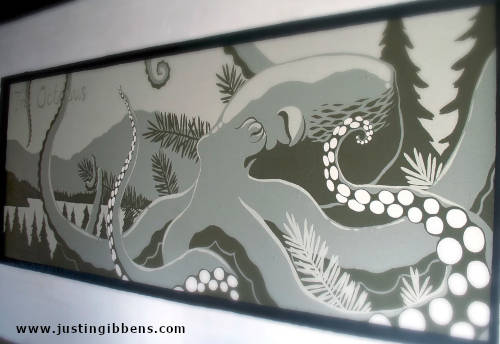
There are 7 other panels, 7 x 17 feet each, that showcase "historical and contemporary cryptids that inhabit the collective imagination of the Pacific Northwest", including: Sasquatch, Thunderbird, Skin-walker, Pacific Merman, Ogopogo, Jakalope, and Ozwald the flying monkey.
The mural is under the BNSF rail tunnel on S. Post Street (Google maps link -- Google's street view doesn't currently show the tree octopus panel very clearly since it's along the lane Google's car didn't go down).