I met a customer from a Goodwill store,
Who said: A desktop computer of beige
Sits on the back shelf. On it, o'er a door,
A sticker stuck still advertised: storage,
And fax modem, and Intel processor;
Tells that its maker well those features met
Which yet survive, ready for lifeless screens,
The four-gig hard-drive, and micro diskette;
And on the bay coverplate, these words entreat:
"etower 500is, eMachines;
This computer is NEVER OBSOLETE!"
No one around exclaims. Late on Monday
In dusty store it stays, tower discrete,
Priced with orange tag; the sale ends today.
 "Serving the Paranoid
since 1997"

Obsoletias
Lyle Zapato | 2022-11-24.0320 LMT | Technology | Retro | Random Found Thing
Fae Archaic: A Crime-ridden Fairy Tale
Lyle Zapato | 2019-06-03.4950 LMT | Cephalopods
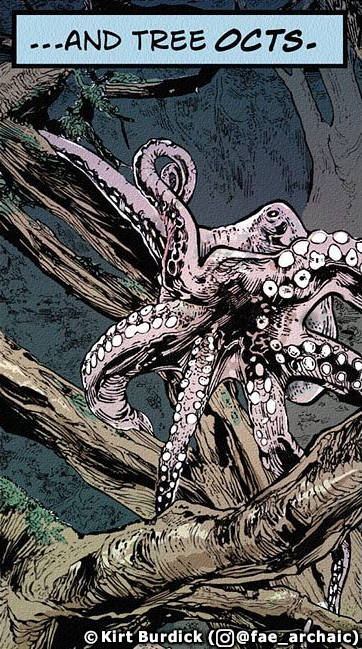
Fae Archaic is a graphic novel by Kirt Burdick set in a fantasy world where faeries ride toads, bats, and monkeys while engaging in various schemes and political intrigues.
I've only read the samples he's posted, but part of the story seems to follow a crusty old faerie smuggler named the Autumn Sailor whose toad mount has become possessed by the spirit of another faerie named Jocker Blune, who died in some sort of weird ritual at the hands of literally blood-thirsty ruling society faeries. Blune uses his psychic connection through the toad to twist Autumn Sailor's mind into a "bizarre tapestry of paranoia and fear" to some end...
Of particular interest to me, one of the dangers faerie smugglers must deal with in the Fenceland Forest are tree octopuses, or "arborland flesh-webs".

Tree Octopus Mural In Spokane
Lyle Zapato | 2019-02-25.8530 LMT | Cephalopods | Sasquatch Issues | Cascadia | Nature
Pacific Northwest Legends: A Natural History is a 2015 mural project in Spokane, WA by Justin Gibbens with assistance by Will Bow that includes a panel dedicated to the Pacific Northwest Tree Octopus (and obviously inspired by the poster I made):
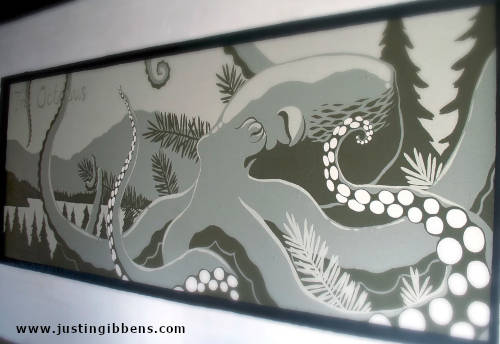
There are 7 other panels, 7 x 17 feet each, that showcase "historical and contemporary cryptids that inhabit the collective imagination of the Pacific Northwest", including: Sasquatch, Thunderbird, Skin-walker, Pacific Merman, Ogopogo, Jakalope, and Ozwald the flying monkey.
The mural is under the BNSF rail tunnel on S. Post Street (Google maps link -- Google's street view doesn't currently show the tree octopus panel very clearly since it's along the lane Google's car didn't go down).

Augmented Hand Series
Lyle Zapato | 2015-05-21.6820 LMT | Polydactylism | Technology
Want to experience polydactylightenment without surgery, mutagens, or psychotropics? There's an art installation for that:
The "Augmented Hand Series" (by Golan Levin, Chris Sugrue, and Kyle McDonald, 2013-2015) is a real-time, interactive software system that presents playful, dreamlike, and uncanny transformations of its visitors' hands.
As one seven-year-old visitor succinctly puts it: "It's a box. You put your hand in it. You see your hand with an extra finger." More from the Augmented Hand Series site:
Hildegard von Bingen's Octopus Visions
Lyle Zapato | 2014-11-11.6090 LMT | Cephalopods | Retro

In 1141, a land octopus living in the spandrels of the convent of Disibodenberg, in Germany, visited Hildegard von Bingen, the new head nun, and gave her visions, most likely via a combination of chromatophoric signals and pressure phosphenes from palpation of her eyeballs.
Being as she was steeped in her religion, and with the obvious cross-species language difficulties, she misinterpreted the octopus' attempt at communication as messages from the "voice of heaven". She recorded her theological interpretations of these visions in her book, Scivias ("know the ways"), which included the above illumination in the frontispiece.
Unlike later illustrations of her receiving the visions, which show divine light-rays from the sky as would suit the presumptions of the time, this original one was either done by her or made from her sketches. In fact, the image shows her sketching on a wax tablet, perhaps recording the event as it happened. So it's the most accurate depiction of the encounter -- one clearly more cephalopodic than theophanic.
(Thanks to reader Rich Thomas for bringing this to my attention.)
Helicopters Unwelcome In Blythe
Lyle Zapato | 2014-07-04.5725 LMT | Black Helicopters
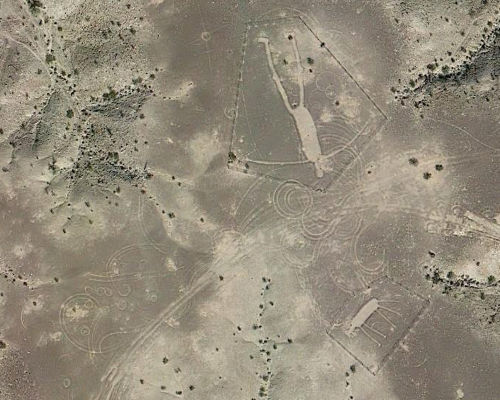
The Blythe Intaglios (or geoglyphs) are found near Blythe, CA in the Colorado Desert. They include figures of humanoids and tailed quadrupeds that were created anywhere from 450 to 10,000 years ago. Some believe the glyphs represent mythic characters from Quechan history and cosmology, while others see it as evidence that the region is La Cuna de Aztlán, the legendary homeland of the Aztec.
The present is just a continuation of the past; and the site has not remained fixed in time, as modern peoples have added to the messages of the ancients. The most visible additions are the swirling tire tracks that some ethnographers believe represent an Atomic Age creation story, depicting the tracks of subatomic particles first seen in bubble chambers and since sublimated into the collective unconscious of drunk rednecks in pickup trucks.
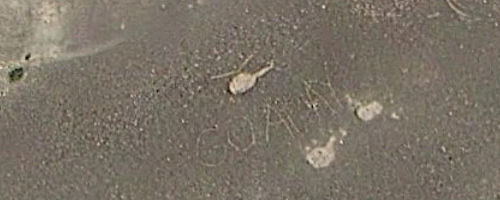
Then there's this addition, presumably a message from a local paranoid directed at black helicopters:
(Indirectly via BLDGBLOG.)
NSA Acknowledged Existence of Y.R. Tap
Lyle Zapato | 2014-06-10.8350 LMT | Government Propaganda Mascots
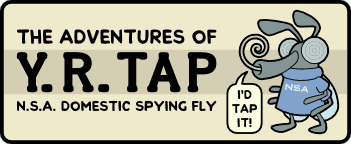
In 2006, I posted about the then-new CryptoKids, official propaganda mascots of the NSA. I pointed out that there was an unshown member of the CryptoKid team that the NSA refused to acknowledge: Y.R. Tap, the domestic spying fly, whose extortionist adventures I imagined in a series of web comics. But, it turns out that the NSA did show Tap, albeit through a semi-official channel.
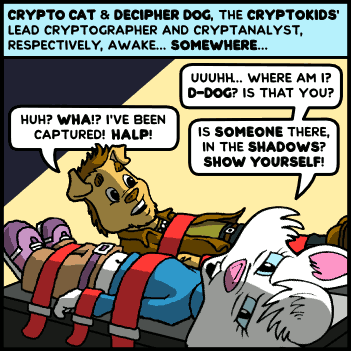
The National Cryptologic Museum, which has close ties to the NSA (although operated via a non-profit org out of a former motel two blocks from NSA HQ), publishes a bulletin for donating members called The Link. In the Winter 2005-2006 issue (PDF), they had an article on the CryptoKids (page 15). Notice who's creeping about in the lower right:
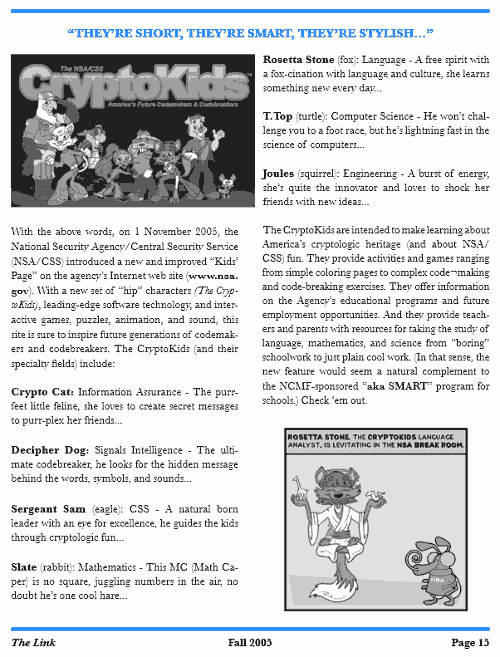
Of course they don't acknowledge him in the text -- no one likes Y.R. Tap! -- but he is there. Watching. Always watching.
(That image is the first panel of my Y.R. Tap Comic #3. The page is dated "Fall 2005" but obviously it was made sometime after May 2006. I don't know if whoever put it there did so intentionally as a joke or if they just Googled "CryptoKids" and thought my site was an official organ of the NSA... It's not, by the way.)
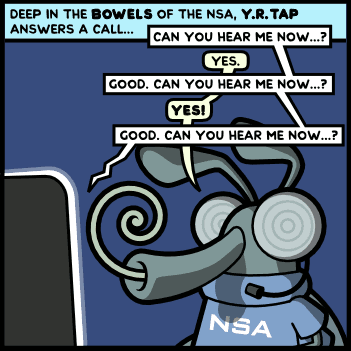
UPDATE: ...and they've since removed the PDF. It was probably a mistake that they made the back issues freely available since they weren't linked to on the public site. I only found it by accident doing a Google image search on a Y.R. Tap panel. I just did another search to see if I could find it again and instead found this amusing appropriation in a PDF of an ESL quiz from a university in Brazil:

© 2004-2024 Lyle Zapato & ZPi
unless otherwise noted or implied.