 ZPi Cephalopod News
2007: LARGER COLOSSAL SQUID CAUGHT!
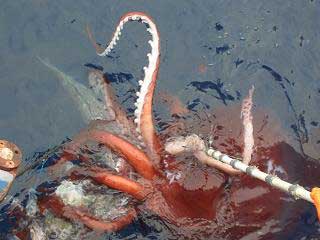
Colossal squid announced caught Feb. 22, 2007.
[UPDATED: 2008-05-02]
Links to information on the colossal squid (Mesonychoteuthis hamiltoni) whose capture was announced on Feb. 22, 2007 (for additional info on colossal squid, see the report from 2003 below and Wikipedia: Colossal Squid):
The squid is being held on ice at Museum of New Zealand Te Papa Tongarewa. Te Papa has a blog with their findings from the disection, with photos and video as well as a schedule and general information page.
- 2008-05-01 Colossal Squid Has Glowing "Cloaking Device," Huge Eyes (National Geographic)
- 2008-04-29 B.T.W. - it's a girl (Te Papa)
- "We just found the ovaries - the specimen is a girl!"
- 2008-04-29 Colossal Squid Goes Under Knife (BBC)
- Scientists in New Zealand will shortly put their rare intact colossal squid specimen under the dissection knife.
- 2008-04-27 New Zealand Squid Thaw Put On Ice (BBC)
- Technicians in New Zealand have postponed until Monday the delicate process of defrosting a colossal squid caught in Antarctic waters last year.
- 2008-04-17 Global Interest Expected In Defrosting Of "T-Rex" Squid (NZ Herald)
- Researchers expect huge scientific interest as they thaw the largest known specimen of the world's biggest invertebrate, a colossal squid, at the Museum of New Zealand on April 30.
- 2007-03-23 Aussie Offers To Help Defrost NZ Squid (The Age)
- Nguyen Tran, a professor in microwave engineering at Melbourne's Swinburne University, said he'd made a machine large enough to take the 495kg colossal squid.
- 2007-03-22 Colossal Squid May Be Headed For The Oven In New Zealand (Canada.com)
- In order to avoid partial rotting, industrial microwave equipment is being considered for thawing the frozen squid.
- 2007-03-21 Scientists Flooded With Squid Ideas (TVNZ)
- Te Papa Museum scientists have been inundated with suggestions about how to defrost their newest acquisition, the world's largest squid.
- 2007-03-15 Colossal Squid's Headache For Science (BBC)
- 2007-03-14 Te Papa Gets Largest Ever Squid Specimen (Te Papa press release)
- 2007-03-13 Giant Squid Off To Te Papa (Timaru Herald)
- 2007-03-13 Massive Squid To Be Shipped To Museum (AAP)
- 2007-03-07 Monster of the Deep (Newsweek)
- How the world's largest squid was caught -- and the bidding war for the exclusive footage slated to be shown this spring.
- 2007-02-23 Colossal Squid Rivals Giant Squid (NHM, UK)
- 2007-02-23 Captain who caught giant squid relives the moment (NZ Herald)
- 2007-02-23 All eyes on Colossal squid (TVNZ)
- 2007-02-22 Big Squid Hooked (The Age)
- 2007-02-22 Displaying colossal squid a "mammoth task" (Stuff.nz)
- 2007-02-22 Photos (Pharyngula blog).
- More sources at The Octopus News Magazine Online message board thread...
2007 colossal squid factoids (updated as new factoids come in):
- Caught beginning of February, 2007; first announced on Feb. 22.
- Estimated 10 meters long
- Revised weight: 495kg
- 195kg more than one caught in 2003
- Original estimate when caught was 450kg
- Caught live (barely) in the Ross Sea by New Zealand fishermen on the Nelson trawler San Aspiring working for Sanford Ltd. (whose fishermen were also responsible for the one from 2003 report below).
- It took nine crew members two hours to bring it aboard.
- Was put on ice below deck, taking up two-thirds of the 1200 liter container.
- This is trawler skipper John Bennett's second colossal squid, his first was from 2002. [Unclear if this was the one from the 2003 report. Check when that one was actually caught -- might have been reported later.]
- Video footage of the squid being hauled in was shot by Bennett.
- Was sold to a production company in Auckland for an undisclosed amount.
- A documentary featuring the footage should be released sometime in April.
- It was minding its own business, peacefully eating a 30kg Patagonian toothfish that the San Aspiring had caught on a long-line at a depth of 1800m.
- Calamari rings made from it would be approximately 1 tts ("tractor tire size", standard unit for such occasions).
- However, deemed more valuable to science than food industry.
- Analyzing stomach contents will reveal its diet.
- DNA analysis will tell how closely related it is to other squid species.
- Isotope analysis of tissue might tell where it lived and extent of range.
- Squid expert Steve O'Shea says it is worth "many, many millions of dollars" and that "any museum in the world would do anything to get this animal," but that its scientific value is priceless.
- Under the terms of the international fishing agreement, squid belongs to the New Zealand government.
- Was in cryogenic suspension (i.e. frozen in a coolroom at the Sanford facility in Timaru) in a "pelican container".
- Was transferred to the Museum of New Zealand Te Papa Tongarewa in Wellington on March 13, 2007 for preservation, study, and display to public as part of their National Environment collection.
- Will be preserved.
- Was frozen in a one-cubic-metre block of ice, has since been thawed on Sunday, 28 April and examined on Wednesday, 30 April, 2008 (NZ time).
- Renovation at Te Papa's storage area to build a special tank to house it.
- The use of microwaves equivalents (such as are used by industry for treating timber) was considered to speed the thawing so as to avoid having outer parts rot before inner parts are fully thawed. Instead they slowly thawed it in a saline solution.
- Known to be female. Ovaries found during examination.
- Beak is smaller than ones found in whale stomachs. Suggests colossal squid can get much larger than this specimen.
2003: COLOSSAL SQUID CAUGHT!


(Images from articles. Click for source.)
Fishermen near Antarctica have caught a rare, virtually intact specimen of Mesonychoteuthis hamiltoni (or as it is now being called, the "colossal squid") -- a very large, very aggressive squid with scores of razor-sharp hooks on its tentacles. Articles:
- 2003-04-03 Colossal Squid A Formidable Customer (Photo) (New Zealand Herald)
- 2003-04-03 Giant Sea Monsters Are Real (Photo) (Stuff.co.nz)
- 2003-04-03 Huge Squid Caught in Antarctic Waters (Photo) (AP)
- 2003-04-03 Rare Colossal Squid Found Near Antarctica (Photo) (Reuters)
- 2003-04-02 Super Squid Surfaces In Antarctic (Photos, more details) (BBC)
- 2003-04-01 Sighting Raises Fear Of Giant Killer Squid (Stuff.co.nz)
- 2003-04-03 Giant Sea Monsters Are Real (Photo) (Stuff.co.nz)
2003-05-10 - Many of the articles above mention that M. hamiltoni has "eyes as big as dinner plates" or such. However, I received an email from a reader contesting this characterization, saying that this is a misunderstood/confused reference to Architeuthis (aka "giant squid", see link for drawing), which the Smithsonian Institute's website says has eyes 25 cm in diameter.
2003-05-12 - Here is the reader's follow up email:
At page 252 of Richard Ellis' "Monsters of the sea", you'll find a B/W photograph of a whole Mesonychoteuthis Hamiltoni. As a matter of fact, it's quite difficult to clearly see the eyes on it, but you can nevertheless see they definitely are NOT that big.
You will make the same statement when looking at the drawings in the "Featured cephalopod" from your own site.
The only scientific reference I could find (in a French book) was "eyes big" ("yeux grands"), used as well for a lot of other squids... and which has nothing in common as the "eyes the size of a dinner plate" formula commonly used for (huge!) Architeuthis.
It's definitely a pity that no website, newspaper or magazine published any photograph of the whole "colossal squid" found some five weeks ago, so that we can see the eyes. Personnally, I should say they must be some 2/3 inches (5/7.5 cm) in diameter, which is quite big... but very smaller than a mere coffee-cup saucer.
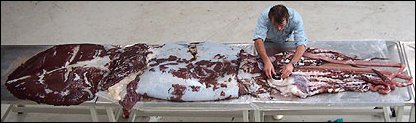
He later sent this picture from the BBC article which shows Steve O'Shea examining what might be the eye (or it could be the beak, compare with the beak image above [EDIT 2003-05-24: It is the beak, see reply below]):
2003-05-22 - There's a thread started on the Octopus News Magazine Online message board about this question.
2003-05-24 - And here's the reply from Steve O'Shea, posted above and emailed:
Hi. It is the beak that I am examining in that picture.
The specimen (Mesonychoteuthis) is the largest thus far known of this species, but was extensively damaged (it was in 3 pieces and has been reassembled in the picture). Both eyes were destroyed at capture, so no better images exist (for this specimen). What did exist were fragments of the eyes, the sockets into which they were positioned in the cranium, and several pieces of tissue with the ventral photophore (crescentric). They were of a significant size.
The 1981 Russian image reproduced in Ellis's book is of an animal lying on its dorsal surface. What is visible is the funnel and two large, partially obscured bulges either side of the arm crown (at the base). These large bulges are the eyes. Having seen in excess of 105 Architeuthis specimens I can assure you that the eyes of Mesonychoteuthis are larger than anything known for Architeuthis. I can also assure you, based on the size of beaks recovered from sperm whale stomach contents (with lower beak rostral lengths [LRL] reaching 48 mm) (our recently reported 2.5 metre mantle length specimen [with a 37mm LRL]), that the animal in the picture nowhere approaches the maximum size that this animal attains, and that it is smaller than the specimen that we recently reported.
Over the past 8 years we have done everything we can to reduce the reported lengths and weights of Architeuthis, not exaggerate them. Similarly, when this specimen of Mesonychoteuthis was first brought to our attention we expected that it too had been exaggerated. When examining it we expected it to be fully mature, we expected the beaks to be as large as those (or very close to in terms of size) those reported from stomach contents of sperm whales. We were amazed that they were not. If this animal does attain a mantle length between 4 and 5 metres then it truly is one most formidable monster; it was frightening enough at 2.5 metres!
With kindest regards
Steve O'Shea
All headlines, blurbs, and photos are the property of their respective owners and are used without permission for the sake of driving traffic to their sites. Contact lyle at zapatopi dot net if this is a problem. None of the sites linked to are in any way associated with Zapato Productions Intradimensional.

